Showing posts with label Dacomatic Recordak. Show all posts

Saturday, December 26, 2015

Fall Color

Okay, that title is a little misleading since I am only going to show black and white photos in this post. But I was out around the neighborhood shooting some colorful leaves the other day and the film I had loaded in my Pentax K1000 was my trusty Kodak Recordak Dacomatic. This film was intended for use in the Recordak Microfilmer.


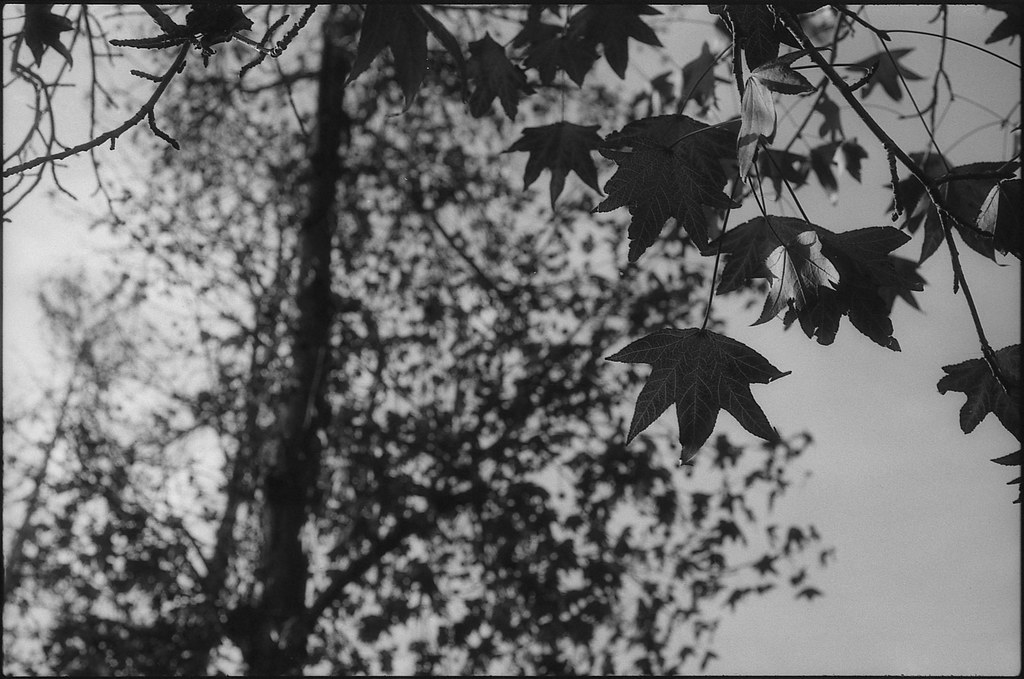
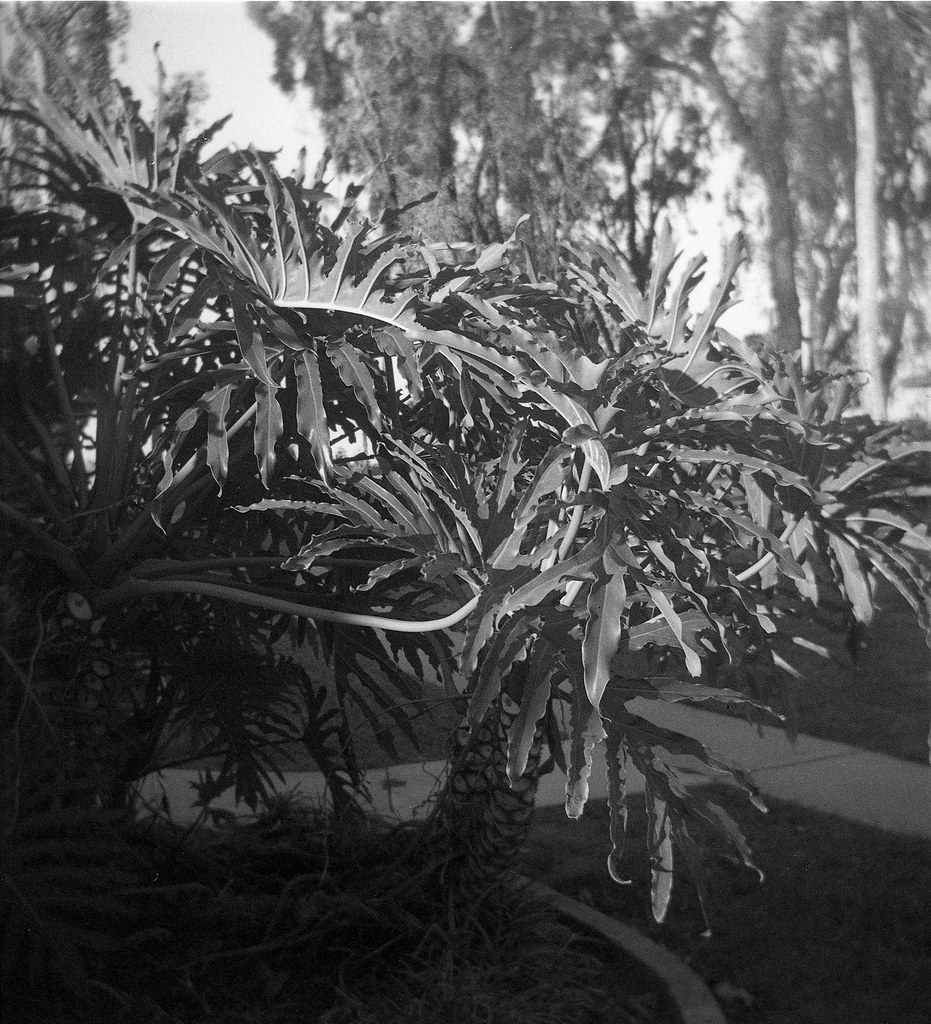
I am old enough to have used microfilm and microfiche in college. It was just for copying text and half-tone images, so really it was just a high contrast medium, not intended for pictorial use at all. There was no need for it to be even panchromatic (sensitive to all visible wavelengths of light), so it was orthochromatic (sensitive to the blue/uv end of the spectrum). That means that red things tend to be dark, even black when photographed with this film. So I had this in mind when I went out for my walk. There aren't many colorful trees here in San Diego, but one that does turn a nice color is the liquidambar tree. The leaves turn a deep red color from November throughout the winter. If there isn't much wind or rain, many leaves stay on the tree. So I decided to try a few shots of these red leaves using my orthochromatic (red insensitive) film. I got pretty much what I thought I would... some very dark colored leaves with good detail. I developed the film in X-tol diluted around 1+3 for 11 minutes with agitation every 30 sec. The film was exposed at EI 100 which is a little fast for this, especially with red subjects, but I still got some decent images.


K1000-Dacomatic-004
K1000-Dacomatic-002

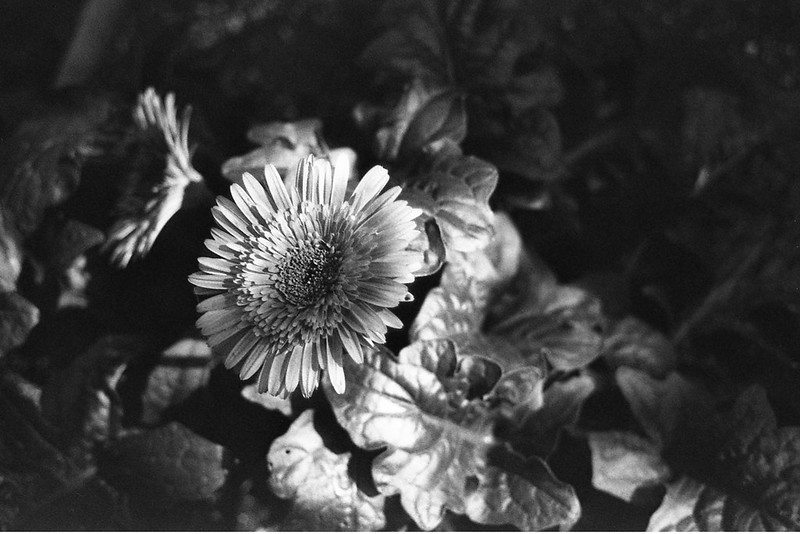
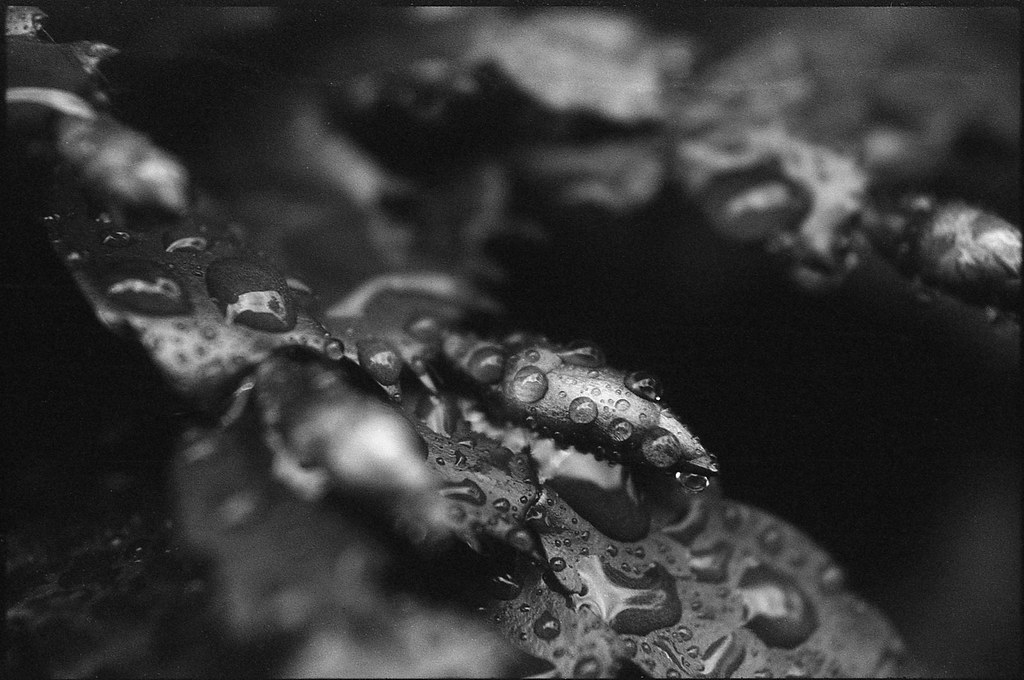
This last one is of a red Christmas Cactus with some water drops. The red subject with this film becomes pretty abstract, which I often like.


K1000-Dacomatic-020

I hope you enjoyed this little trip down 'Orthochromatic Lane'. Expired microfilm is a fun change of pace for people who like black and white images, but are a little bored with the usual offerings of Tri-X and FP5. Give it a shot and let me know how it goes!

Tuesday, August 18, 2015

Eucalyptol

One or both of my readers (hi mom) may be familiar with the b/w film developer Caffenol. This is made with instant coffee, washing soda and vitamin C powder. It is environmentally friendly, cheap, high quality, easy and cheap. Alright, I am cheap and Rodinal might be a little cheaper than Caffenol, but there is just something very cool about mixing household ingredients and getting film developer out of it. So I occasionally mix up a batch when I have time. There are examples around here.

Recently, there was a discussion of the active ingredient. It turns out NOT to be caffeine, but caffeic acid. So that begs the question (for me): What else has caffeic acid in it that might be readily available? The answer: The bark of Eucalyptus globulus (according to Wikipedia). This is an Australian native tree that happens to be a common invasive species in So. Cal. where I live. In fact, there are big ones just outside my front door. So it is very simple for me to step outside and collect some bark off the ground, and that's just what I did. I didn't weigh it or anything, this was more of a 'proof of concept' experiment than an optimization. So the best I could say about the quantity used would be 'a couple of handfuls'. I took it inside and broke it into little pieces, then I put those into my coffee grinder. Legal Disclaimer: Do not use anything you plan to later use for food prep when preparing photographic chemistry. I ground it up pretty fine and put it into a pint mason jar. Then I poured boiling water in and let it steep for about 30 minutes. I then poured the liquid through a coffee filter and discarded the used bark. I have absolutely no idea how much caffeic acid is in this tea (if any). I subsequently did some Google Scholar research and found a paper where the researchers could not detect caffeic acid in the bark of Eucalyptus globulus. That was discouraging, but I had come this far, so I decided to at least do a drop test on a piece of film.

To do a drop test, just get an old piece of film, expose it to the light and put a drop of your developer on it. If it turns black, your developer is active, if not, then it isn't. I had a little over 500mL of eucalyptus tea, so I followed the recipe for Caffenol C-L, adding 16g of Washing Soda and 10g of Vit. C. I didn't add any KBr. Then I topped off to 1L with distilled H2O. The film that needed to be developed was Kadak Recordak Dacomatic. This is copy film with a very thin emulsion layer and no anti-halation layer, so probably would be my best bet if the developer ended up being weak. So I cut the leader from one of my rolls and put a drop of the developer (heretofore known as Eucalyptol) on the emulsion. One minute later... nothing. Give it a little shake. Then it happened. The emulsion started to turn. First just a faint brown, then darker and darker. It was working! I swirled the drop of developer onto a different area of the film and there it sat. Maybe there was a little development, but not much. So there it was. A one-shot developer.

Now to decide on a developing time. I figured I would do a stand development, but I didn't want the bromide drag that comes with it on 35mm film. So I decided 1 hour semi-stand with inversions at 20, and 40 minutes. That way, if the dev was weak, at least I might get thin but scanable negs.

Here are some of the results:
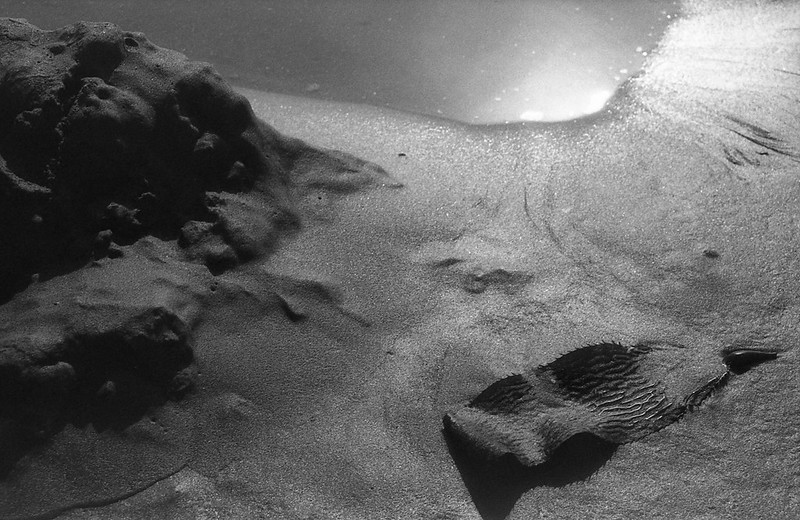
N2020-Dacomatic-004 N2020-Dacomatic-003 N2020-Dacomatic-021 N2020-Dacomatic-018 N2020-Dacomatic-014

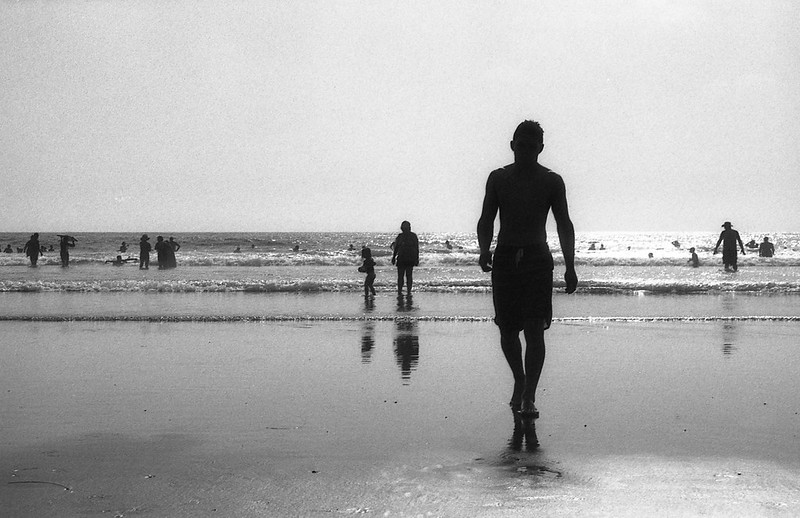
Okay, HCB I am not, but you get the idea. The tonal scale is compressed (more contrast), though part of that is attributable to the fact that I was shooting mostly in full sun, mid-day at the freakin' beach. You won't find many more contrasty scenes than that. Also the film itself is intended for copying documents, so contrast is sort of its thing. Normally, I develop this film in Adonal (Rodinal) 1:100 for 70min with inversion initially and at 30 min. That gives a pronounced grain that I find appealing. It's not for everyone, especially those who enjoy the digital aesthetic, but I like the grain. With this developer, I am going to call the grain "chunky style", but still not so obtrusive as to be distracting. Additionally, while I was doing some light dust spotting in Photoshop, I did notice some very very small pinholes in the emulsion. These appear as tiny black dots on the scan. My intuition tells me that there could be something in the eucalyptus extract that is being hard on the thin emulsion layer of this film. I am doubtful that I would see it with a regular pictorial photographic film (stay tuned).

Over all, I think this is a good alternative to caffenol for those of us who want to see just how far down we can drive the cost of developing a roll of film in a home-made developer. Here's the math. I used about $0.10 worth of washing soda, about $0.76 worth of vit. C powder, and maybe a nickel's worth of distilled water. So that's around $0.90 in ingredients, not counting the film which was practically free (I think I paid about $0.03/ft). To compare, the same amount of Adonal 1:100 would cost about $0.14. So this isn't really a money saving proposition, especially if you consider the time spent collecting, grinding, steeping and weighing. It is more about the adventure of making something that works. It is closely related to the "maker" movement you see in places like the Maker Faire and Make magazine. It lets us explore our creativity while still engaging our left-brained nature.

Friday, August 15, 2014

"-matic" Squared

I picked up a Kodak Instamatic 500 at my local Goodwill via the Goodwill Auction Site. It is a beauty even though the instamatic format was doomed. The film came in plastic cartridges called "126". The film was actually 35mm stock that was perforated differently (one oval perforation per frame) and the images were square. The other difference was that the film was wound in the cartridge with a paper backing like 120 film. This allowed the cartridge and the cameras to have windows in the back where the frame count was viewed (printed on the paper). There are videos online that demonstrate how to spool regular 35mm film into a 126 cartridge, so I won't belabor that here. I took some of my 400' reel of Dakomatic Recordak and taped it to the backing paper (that's not how they do it in the videos, but I thought it was worth a try). The iso is set by a notch in the cartridge, so I couldn't use the internal meter. I hand metered or used Sunny 16 at iso 25. One of the nice things about this camera is that aperture and shutter speed can be set manually. Most other instamatics are full-auto point & shoot types of cameras, but there were a few that gave control to the photographer. One thing I noticed about this camera is that the shutter is for all intents and purposes, silent. I can barely hear it when I am shooting. If I were to shoot from the hip and not hold it up to my eye, my guess is that no one would even know a photo had been taken. The view finder is big and bright with parallax lines for closer subjects. The meter's match needle is at the bottom of the finder and I find that I have to adjust my eye to see it, but unless I am shooting film that matches the notch on the one cartridge I have, I won't be using it. Focusing is by distance estimation in m or ft (range focusing) or by matching little pictures (a la Holga) with the focus mark. The ranges are on the top of the lens and the pictures are on the bottom. I have gotten used to range focusing with my Voigtländer Bessa, so that is the method I use and I am usually close enough. This lens opens up to f/2.8, so I will have to work on my accuracy if I want to shoot those sweet sweet OOF backgrounds.

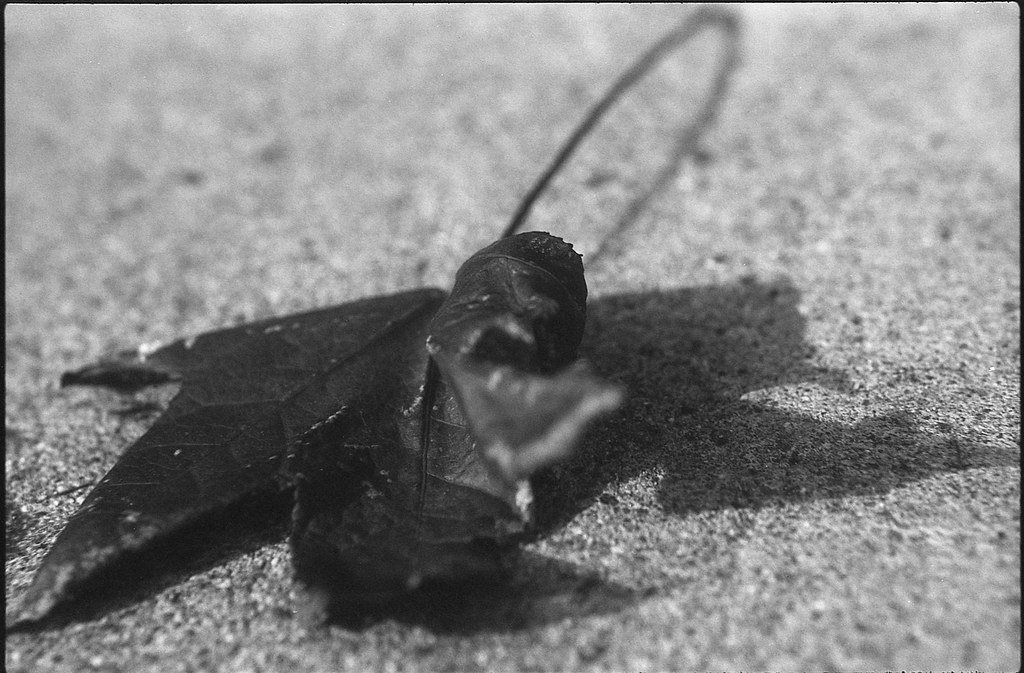
So here is one of the photos I took. Not super exciting, but it does show the contrast and clarity of the Schneider-Kreuznach Xenar f/2.8 38mm 4-element glass lens. There is also a nice little bit of 'swirl' in the corners that adds a little old school charm to the photo. I think I will be loading this camera more frequently and keeping it handy.

Dacomatic in the Instamatic

Wednesday, April 16, 2014

Dacomatic Recordak Film

I have been playing around with expired film recently. This is for a couple of reasons. First, it is economical and I am cheap. ;) Second, and more importantly, I like the look of grainy film. I wouldn't say that I am in the "more grain is better ad infinitum" camp, but I like photos with pronounced grain. In fact, back when I was shooting digital, I would often use grain 'filters' or plug-ins for my photos that needed that extra something. Looking back now, I am surprised that it took me so long to return to film photography, when that is what I wanted my photos to look like all along. As film ages, the ionic silver undergoes subtle chemical changes. The crystals merge and aggregate, cosmic rays and other radiation can 'expose' some crystals, etc. So the net effect is that the film speed (iso rating) gets lower, the grain gets bigger and the base fog becomes more noticeable. Some of this can be overcome when you develop your film if you are trying to get a 'cleaner' look from your expired film. I use one of two developers (Rodinal or Caffenol-CL), neither of which is very good at compensating for these side effects of elderly film. So I shoot the film and live with what I get, which is usually pretty close if not exactly the look I am going for.

Recently, I acquired a 400 foot roll of some well-expired 35mm film. It is Kodak Dacomatic A film, expired in Dec. 1973. I was only 6 years old when this expired!! I bought it on the big auction site and then started trying to figure out what iso it should be shot at and how in the world to develop it. Guess what, there's not much information out there on this film. From what I can gather it was made for use in the Kodak Recordak machine which was used for copying documents. Okay, so it's copy film. That will mean that it is probably high contrast, or at least it was in 1973. I did find one guy on Flickr that had used it and shot it at iso 6. Over on the FilmWasters forum (highly recommended) one of the guys wrote a desktop application that will calculate a reasonably accurate EI for expired film. You can download it HERE. Download those three files and run setup.exe. This application predicts an iso of 6 for film that was originally iso 100. Was that the original speed?? Who knows? Never being one for following rules, or even guidelines, I set my meter to iso 12 just to allow a little more reasonable shutter speeds. I should note that subsequently, another Filmwaster has exposed this same film at iso 80 and got very good results using Blufire HR developer from the Frugal Photographer. Anyway, I rolled some up in a reusable film canister. I had to do this in the dark since my daylight film loader will not hold a 400' roll. So I measured a piece of string as long as a 12-exposure roll of film and taped it to the counter in my darkroom (bathroom). Then I turned out the lights and measured out a piece of film as long as the string. I then taped that to the film spool and rolled it up. I threw this into my trusty old Nikkormat FTn and went out in the sun to find something to shoot. I found myself at The Scripps UCSD Medical Center where they have sculptures and fountains and buildings that might be photogenic.


Here are a couple of shots I took of a marble sculpture of a pair of robed figures looking at each other.

I developed in Caffenol-CL for 60min with no agitation after the first 30sec. You can see that the grain is 'pronounced', but not what I would call 'extreme' or distracting. This is the look I like and why I like to use expired film. Different films age in different ways and storage conditions play a big part in whether they are usable or not. If you are buying very old film (more than 5yrs past expiration) you probably want to verify with the seller that it was in cold storage. You may get an image out of film stored in a closet, but it will be pretty faint. Just experiment and have fun with these old stocks!