Showing posts with label film photography. Show all posts

Wednesday, December 23, 2020

Shoot Like Your Grandpa

This shotgun belonged to my great grandfather Roy Harr. It is a 2-round German Mauser bolt action Geha shotgun in 12ga. Now there's a lot to unpack there, but let me start by tying this back in to one of my previous "Like Your Grandpa" posts. In the first post in the series "Shave Like Your Grandpa" I talked about rituals and how we (mostly men) thrive on them. That was in the context of the shaving ritual, but shooting is not really different. In fact, I would argue that for shooting or handling any dangerous object, a ritual is critically important. Shooting is a rather long and involved ritual, especially with antique weapons like this. When you first lay your hands on a weapon, the first step in the ritual is to check to make sure that it is 'clear' (that is, not loaded). Then you might inspect it to make sure it is clean and in good working order. Once you are in a safe place to fire, you would load the weapon and at this point there are a number of safety "rituals" to follow (keep your finger off the trigger, don't point it at anything you don't want to destroy, etc.). Then there is the ritual of actually aiming, firing and in the case of bolt action firearms, ejecting the spent round and chambering the next. Attention to detail and doing things in the right order are important. So this is the appeal for me. I'm not a hunter. I'm a hobbyist. I shoot paper targets at the shooting range for fun. Part of that fun is getting the ritual right and seeing a good result.

Now about this shotgun... When Germany signed the Treaty of Versailles ending WWI in 1919, they agreed to not produce military arms. They could produce 'sporting arms' though. Now they had a large surplus of Mauser military rifles, so what to do with them? Melting them down seemed like a waste of a resource, so they decided to convert the rifles into shotguns. The shotguns were sold to farmers and hunters under a few different brands, Geha being one. My great grandpa Harr probably bought this new and used it on his farm in Washington state. When it was eventually handed to me by my uncle it hadn't been fired in many decades. I cleaned it and took it to a gunsmith to have it inspected. He said it was good to fire. There are many arguements in the shotgun community as to whether these are actually safe to fire. There are apocryphal and third hand stories of catastrophic failures, but I've yet to read anything that leads me to believe that they are dangerous in any systemic way. Remember these were built to withstand the high pressures of military rifle ammunition and so are "over-built" for the lower pressure of shotgun shells. The shotgun holds 2 rounds. I like to shoot a shell with bird shot followed by one with 00 buck shot. It's fun to feel the difference in the two rounds one right after the other. Of course the bird shot obliterates the paper target, so you can't really see the spread of the buck shot after that, but it's really just about the experience. No one shoots stationary paper targets at the range to improve their accuracy with a shotgun.

  • Camera: Standard Cameras 4x5 1.0
  • Film: Kodak Clinic Select Green x-ray film
  • Developer: DIY Parodinal 1:100 x 4 minutes
  • Fixer: Sodium Thiosufate/Sodium Sulfate basic non-hardening fixer

Sunday, October 14, 2018

Worthy of Redundancy

Ultrafine Xtreme! It seems a little silly to brand something with "Ultra" and "Extreme" in the title. In Latin, the prefix 'ultra' means 'extremely' or 'beyond'. So they are trying to send a message here. They want us to know that this film is fine grained. Now if you've shot enough film, you know that these claims are largely created by the marketing department of the film company and don't always hold true in real life. Especially with black and white film, grain is affected by so many variables from EI (exposure index or apparent iso) to the plethora of developers, dilutions, temperatures, agitation schemes... The list goes on. So I'll be forgiven if I approach "Ultrafine Xtreme" film with a touch of skepticism. This is compounded by the very (not Xtremely) reasonable price, which in Western culture means lower quality. I bought 10 rolls of 120 Ultrafine Xtreme 100 for around $5 per roll. For comparison, Ilford Delta 100 and Kodak T-Max 100 are both over the $6 mark (what? no more Acros 100?? BOOOOO! to Fuji!!!). So let's see what my $1 per roll savings is going to cost me.

I loaded my roll up in my 'chrome-tastic' Bronica S2a (read more about that camera here) with the always pleasant and reliable Nikkor-O-C 50mm f/2.8 lens. This is the sharpest medium format option I have and a great camera to use, so why not? I shot the film at iso 100 because that's what the box says on it. Can I push it? Can I pull it? What are it's reciprocity characteristics? None of these questions mattered. I just wanted to shoot it straight and see what the baseline is. And that's what I did.

Before I get to the shots, I'll describe my development scheme briefly for the home developers out there that nerd out on this kind of stuff. I used two DIY developers mixed together. First was My-tol (Kodak X-tol look-alike). I mixed that up at 2:1. Then I added some Parodinal at 1:100. I developed the film for 11 minutes at around 70F using the usual agitation scheme (constant for the first minute and then 4 inversions every 30 seconds). Fixer was Ilford Rapid Fix 1:4. There, how's that for brief?

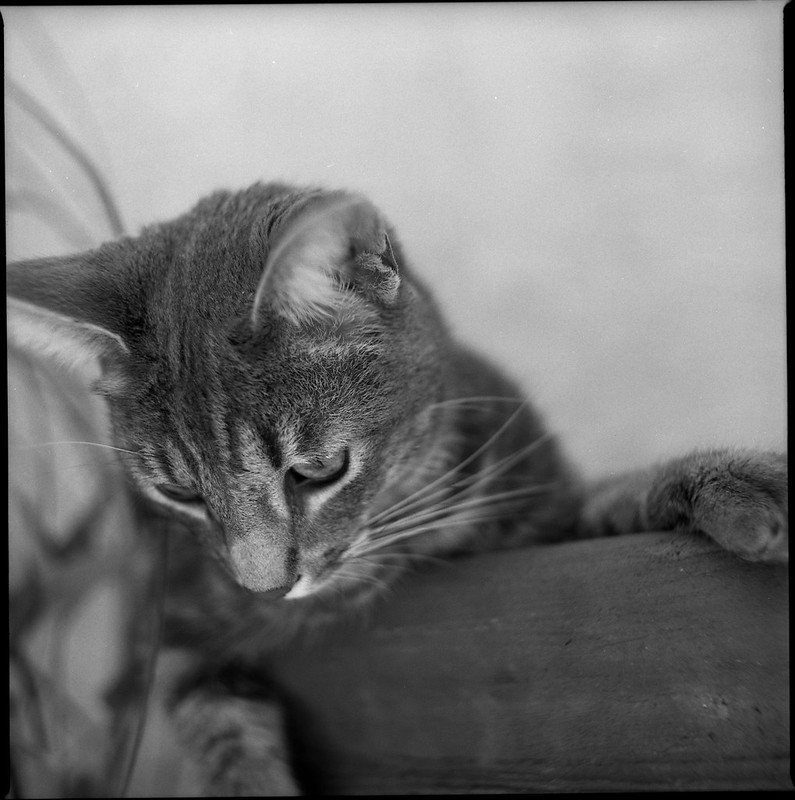
One of the tough subjects when it comes to fine grain and sharp lenses is animal fur. I scanned this shot at 1200 dpi and I think I am running out of pixels before I run into grain.

Scratchy McBiterton

Here is a 100% crop of that shot.

I have to say I was impressed. At least with this developurr combination (sorry), this film does indeed show very very fine grain. Is it "Ultrafine"? Well, we are dealing with sort of subjective, qualitative terminology here, so I'm going to say YES! It is Ultrafine! Put this film behind your sharpest lens, develop it with a high accutance developer, and be confident that you are going to get some Xtremely good results. "But James", you say. "Doesn't high accutance and sharpness mean that the low contrast areas are going to look grainy?" Let's see. Here is a 100% crop of the blank out of focus wall behind the subject.

The answer is "yes, there is some visible grain." Is it distracting? Is it "golf ball grain"? No. It is what I would characterize as "filmy" grain. It's the grain that lets you know that you are shooting film. I personally like grainy film (usually). The exception to that rule was Fuji Acros in Caffenol-CL. That was so smooth and creamy and lovely. I could just stare at the blurry backgrounds. But usually I like to have some grain in the image just as a creative device, sort of like the way I left the S2a film mask in this image as a border. It's a layer of abstraction that adds interest.

Now we come to the 'caveat emptor'. Here we see what saving $1 cost me. There were two shots on the roll of 12 that had artifacts. These looked like perfectly round clear spots on the film. I don't think that they were air bubbles that didn't get developed since that is not ever a problem with my agitation and there were only two of them on the whole roll. I think these are actually flaws in the emulsion. Take a look near the bottom of the gate. I'll keep an eye out for more of these in future rolls. I hope this is a Xtremely rare slip up by the QA department. If it is truly a "feature" of this film, I'll probably spend the extra $1 per roll and use T-max. But if not, if it turns out that Ultrafine Xtreme 100 is a good reliable fine grained film, then I will certainly buy more.

Sunday, June 4, 2017

Gone Microfiche-ing

Using expired film can be a bit of a challenge. There is usually some loss in speed, so the apparent iso (or the effective EI, if you like) is lower and it is up to you as the film adventurer to determine by how much. The rule of thumb says one stop for each decade past its expiration date. So assuming you know the expiration date and didn't just come across a random roll of film, you can use that as a starting point. Keep in mind though that 'fast' films (to me that means iso 100 and higher) will lose speed 'faster' than slow films. So if you have a roll of Ektar 25 that expired in 1997, that's 20 years (two stops lost), but since it was slow film to begin with, it probably didn't lose a full two stops. Maybe 1½ or 1 stop would be a better starting point. "So what's your point here Jimbo?", you may be asking. First, I don't really like "Jimbo", people called me "Jim" in college, but generally, it's just "James" and has been since Mr. Salyers' 4th grade class. Secondly, I'm getting there!

Periodically, I search for Kodak Dacomatic Recordak film to buy. I have some in the fridge and I really like it. So I just keep an eye out for a spool. I never find any. But then one day the search popped a result on the big auction site. It was "Recordak", but didn't say "Dacomatic". Additionally, it was 500 ft of 105 mm stock! Well, that seemed odd, so I did some more digging on the specific emulsion number (4462) and it turned out to be a completely different film (seems obvious now). This one was used for microfiche production. So it was copy film like the Dacomatic, but a different type. The price was right, so I went and bought it, hoping against hope that I could get pictures from it. It originally (expired 12/1979) was rated at iso 2.1! So, figuring that this stuff is really not very sensitive to light to begin with, I figured it probably hasn't lost that much speed even in almost 40 years, but I'll give it a stop anyway. That puts it right about iso 1. Okay, so I have an exposure starting point. How am I going to develop this stuff? It was designed with an automated proprietary development scheme in mind, so all I could find in the VERY sparse documentation was "Microfilm DEVELOPER and Replenisher". That's it. So I figured I would hit up the old stand by, Rodinal 1:100 and do a strip test to see if it would even change color. In fact it did! In about 15 seconds, it was fully developed!! So much for 60 minutes of stand development. Well, I cut a few sheets and took some of what I am certain were the best photos of my entire life and dunked them in what I had on hand, which was some homemade Parodinal 1:100 for 4 minutes. That is what I use for x-ray film and it works just fine. This microfilm however, was completely dark. Hmm... Maybe I over-exposed it? I tried again, taking more absolutely stunning photos at higher and higher speeds. Again, completely dark. So over-exposure was not the problem. It must be over-development. I cut the time in half. Still totally dark. I mean just a dark sheet of film... No image whatsoever. The strip test I did showed that the film cleared completely in the fixer, so it wasn't that the fixer was bad or the film was totally fogged.

I was just about to give up and call it a total loss, but I thought I would just try a different developer for grins. Rodinal variants have always developed anything I threw at them, including a roll of Ansco Plenachrome expired in 1949. But desperate times, you know. I had some X-tol powder laying about and that is a phenidone based developer, so I figured one last try. And this time, I would take a high contrast shot with lots of bright San Diego sky AND I would develop under red safelight by inspection. Did I mention that this film is orthochromatic? No? Well, now I have.

BAM!!!

Recordak-iso-1

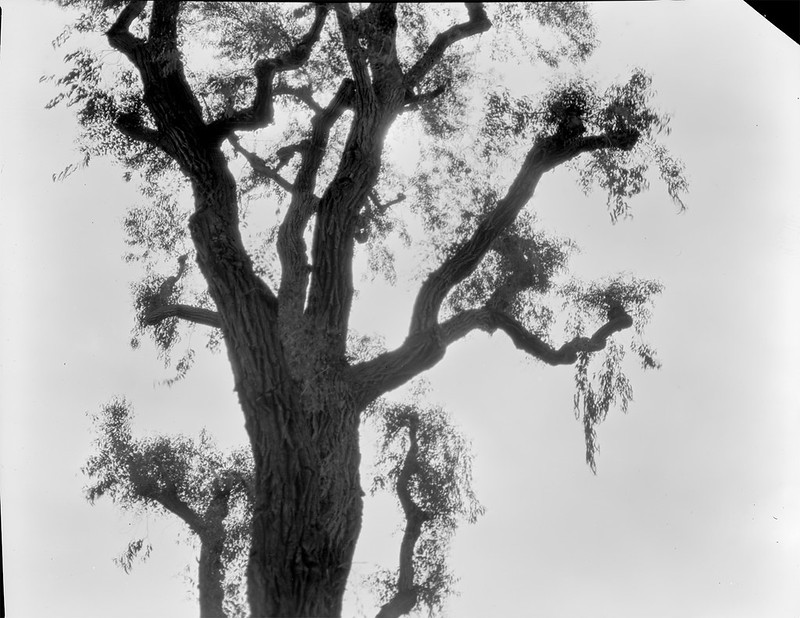
I got an image! That was in X-tol 1:3 for 10 minutes. Now to see if I could get something with a few more grays in there. So I took a shot in the shade. I gave it a little more exposure because I had the bellows extended a bit, but I forgot about the reciprocity failure that was mentioned in the tech doc. The negative was very thin, but still there was a photo and it had much more scale to it. It is still quite fine grained and in 4x5 sheets that means some super fine detail can be had.

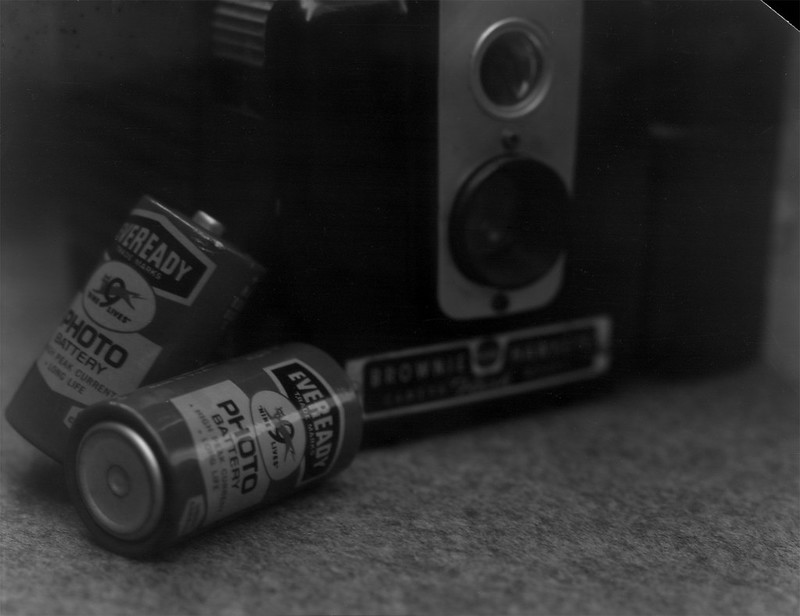
Retro Eveready Photo Cells

Now I've got about 490 feet left of this to see what I can do with this flavor of copy film. I'm looking forward to making some photos with this oddball microfilm.

Tuesday, June 28, 2016

Putting That Chemistry Degree To Work

I have been a user (if not a devoted one) of caffenol ever since I ran into Reinhold's blog and saw the wonderful results he and others like Jon Caradies get with that simple 3-ingredient developer. I do enjoy weighing the ingredients on my little 3-beam balance and making the solution. The smell is a little funky, but I think it's growing on me and I don't mind it so much anymore. I even have my own modest gallery on Flickr where I upload various films both expired and fresh that have been processed with this earth-friendly concoction. Here is the first photo I ever developed and shared that was processed with caffenol-C-L.

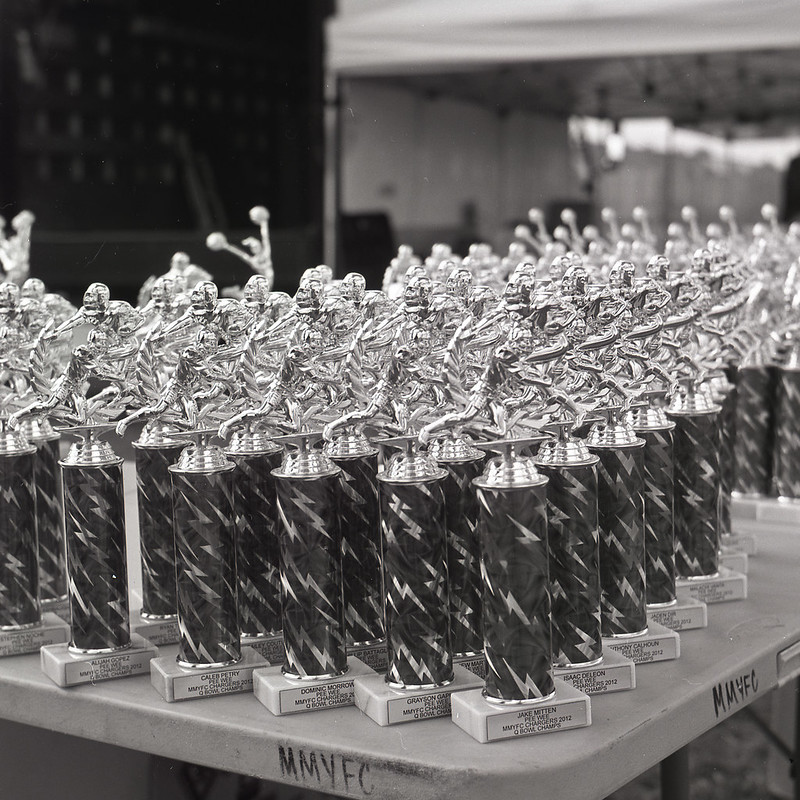
Youth Football Trophies

I even went out on a limb and made my own variant, substituting ground up eucalyptus bark. I called it eucalyptol. You may have read about it HERE. That one needs to be revisited with a little different methodology, but I'll save that for another post. For this post, I want to talk about something very different. Okay, maybe it isn't "very" different. It is still a 3-ingredient developer made with things that are readily available at your local drug store and/or online. I chose to get my ingredients online just because it is easier than driving around to different places trying to find things. So what is this "different" developer? It is called Parodinal because it is a Rodinal clone based on Paracetamol. Paracetamol, also known as Acetaminophen, is the active ingredient in Tylenol which is cheap and abundant. Here is the shopping list and the amounts I use for a single 250 mL batch.

  • 30x 500mg Paracetamol tablets
  • 50gr of Sodium Sulfite (Anhydrous)
  • 20gr of Sodium Hydroxide (Anhydrous)
  • Water (distilled) to make 250ml

I based this recipe on what I found over on Martin Zimelka's blog. He in turn learned about it on APUG (I think).

For my first batch, I went simple. I made the Sodium Hydroxide (drain cleaner crystals) solution, then I just crushed up the Tylenol tablets with a stainless steel mortar and pestle and tossed it in. The Sodium Sulfite did not dissolve even in warm water, so I just combined the two as best I could and figured it would either work or it wouldn't and if it didn't, I'd try something different. But guess what? It worked!

S2a-acros-001

It was a cloudy suspension for sure. The binders and coatings of the ground up tablets did not dissolve and just sort of sat there. They didn't seem to have any effect on the action of the developer and that jives with things I read online. It's just sort of disconcerting to have a cloudy developer. You get the feeling that that all of that sediment is somehow ending up on your film. To get around this, some people either start with neat paracetamol. That gets around the sediment problem, but it is a little more expensive and a little more difficult to obtain. Others filter the binders out of the solution, I suppose with something like a coffee filter. That is also effective, but sheesh! That can take a loooong time to filter. Who has the patience for that? So what is a chemist turned data scientist to do? Extract the paracetamol away from the binders! Alright, so that isn't really going to save me any time. In fact, it's probably going to take a lot longer since I don't have a roto-vap handy. Ah well, it would be fun and interesting to see if I could get a clear developer that worked.

So off I went to the hardware store to find an organic solvent that would dissolve the paracetamol and leave the binders behind. I had done some internet research and found out that methanol is great at dissolving paracetamol. But pure methanol is hard to buy because it is quite poisonous. Next best? Ethanol. Denatured alcohol is mostly ethanol with a little bit of methanol thrown in to make it undrinkable. I ground up 36 tablets, just in case the extraction efficiency was low. I ground them up very fine and poured it into a bottle with 200 mL of denatured ethanol. I shook that for a few minutes. Then I let it settle and poured the supernatant (the clear part) through a coffee filter into a plastic tub. Thinking back, a shallow glass dish would have sped things up. That took about 2.5 days to evaporate. Yeah, I know. Filtering would have been faster, but this has more 'cool factor'. Once the ethanol evaporated, I had a pink-ish powder. I scraped it off the walls and bottom of the tub and weighed out 15g. I ended up with a few grams left over, so that means that the extraction efficiency is quite high. Now I used that as my paracetamol source and followed the recipe as before. Bingo! A nice clear solution (with some of the sodium sulfite settled on the bottom). I let it 'age' for a few days and a sort of 'crust' formed on the top. So I gave it a shake and re-filtered this off along with the extra sulfite. The next day, the usual 'rodinal' crystals formed on the bottom of my bottle and I knew I was in business. I had a nice clear parodinal with preservative crystals. The only thing left to do was to develop some film. So that's what I did.

Isolette-Acros-010

So what are you waiting for. Get out there and make some developer! :)

Monday, February 8, 2016

For the Love of Bakelite!

Bakelite. It sounds like the heat source for one of these.


But it isn't. It's a modern miracle of materials science!! Alright, it isn't so modern, but just because it was invented in 1907 doesn't make it any less miraculous. It was the first synthetic plastic and was developed for its electrical insulation properties. So you could make a telephone casing with it and be pretty confident that when you answered, the person on the other end would hear “Hello?” and not “Gggggrraaaaaahhhhhhhhggg!!!!” It soon became popular to make lots of things with this durable moldable material. And make things they did. Everything from radios, to pipe stems, to automobile dashboards were made from Bakelite.

But you are on the Through a Glass, Darkly blog, not the “Through a Windshield Because They Haven't Invented Seatbelts Yet, Darkly” site, so best we stay on topic. Yes, they made cameras out of Bakelite. They made LOTS of them. Probably the most prolific Bakelite pusher in the photographic world was... yes, you guessed it, Kodak. They made Brownies of all types out of Bakelite and in the 1930's through the 1960's if your family didn't have one, the next door neighbors did. Early Bakelite Brownies took 127 roll film which is not as wide as modern 120 medium format film and usually produced 4x4 cm images. The Bakelite Brownies later evolved to shoot the more popular 6x6 cm format on 120 and 620 (120 film on a different spool) film.

That brings us to one of the most abundant of the Bakelite Brownies, the Brownie Hawkeye Flash Model.
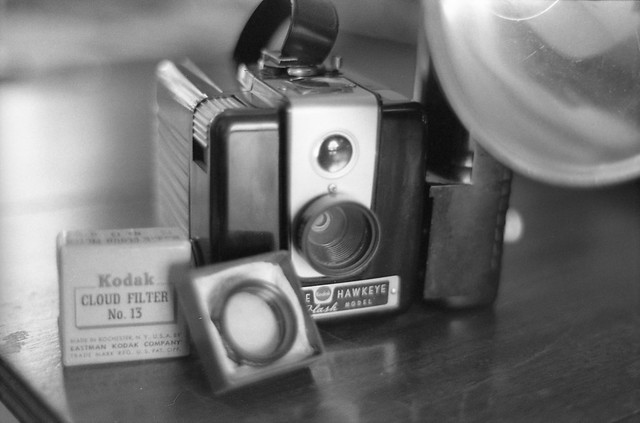
FTn-Tmax400-011

Aside from maybe the Nikon F, this is probably the most thoroughly covered camera on the web. Partly because they last forever and there are still piles of them available in like new condition for practically the cost of shipping, and partly because they are so much fun to use. It took me a while to warm up to the idea of getting one of these little black boxes. I had read enough and seen enough pictures from them to know that they were capable little cameras, but the point and shoot nature sort of turned up my snob dial and I resisted the urge to drop $5 on such a common piece of equipment. One day however, I was perusing an auction site (not the one you are thinking of… yes, the other one) and there was one listed for $5 with local pick up available. Okay, a fiver and no tax or shipping... What's the worst that could happen? So I won the “auction”. Really there isn't much in the way of actual bidding on these, so that was just a waiting game. I went downtown and picked up my first BHF (that's short for Brownie Hawkeye Flash among BHF owners – yes that's a thing) and the first thing that happened was the clerk dropped it on the concrete floor. I fully expected to be picking up little bits of BHF but the thing bounced a little and there was one small chip that I didn't even notice until days later. I decided to do a thorough cleaning and prepared my tools and rags and pointy things for tiny crevices, but all I needed was a Philips head screwdriver. That's it. I didn't even have to consult the Googlz. It is so simple to take it down to a reasonable number of components and clean them. So there I was. I had a BHF that looked and worked like the day it rolled off the production line, which thanks to the CAMEROSITY code (YSRM), I know was in July of 1953.

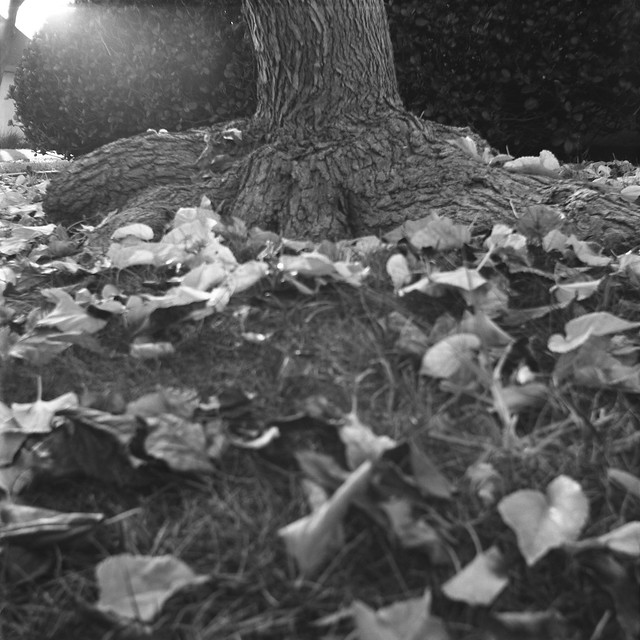
Now what is it about this camera that would inspire so many to devote their time and creative juju to it? Well, I can't speak for others, but have I mentioned it's made of Bakelite? That puts it pretty firmly into the “cool junk” category and I've heard that chicks dig that. The simple meniscus lens keeps it sharp in the center from about 5 – 15 feet and just slightly softer around the corners.
BHF-Acros-009

Obviously, if you live and die on Mount Hassy, this may not be for you, but if you want to go even deeper into the soft corner abyss, you can simply take the lens out and flip it around. That gives a sharp center circle but the outer parts of the image quickly fly apart into a nightmarish spectacle that you will never want to wake up from.

hawkeye-004

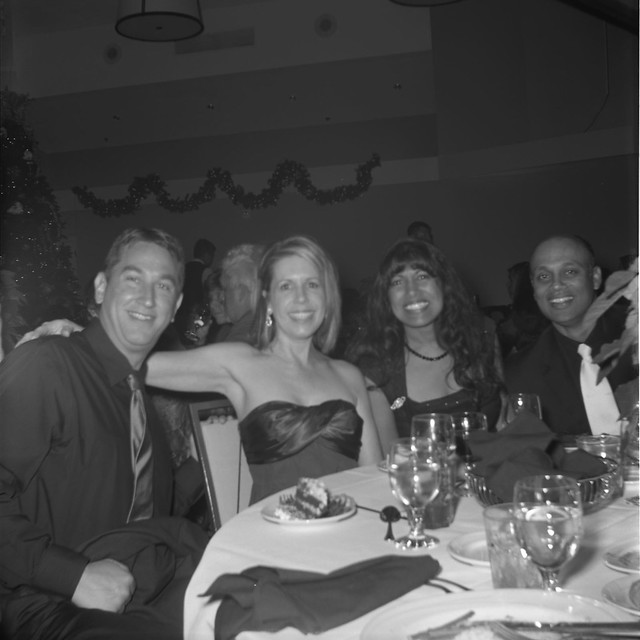
This is a fixed focus, fixed aperture, fixed shutter speed camera, so "point and shoot" in every sense of the word except that you have to remember to wind the film. There is no protection against double, triple or tredecuple (it's a word, look it up) exposures, so wind first or wind last, but do it every time. There is a bulb setting for long exposures, but there is no tripod socket, so good luck with that (keep reading if you want to know what the "bulb" setting is really for). Not having control over aperture or shutter speed makes the choice of film important. These cameras were made before fast emulsions, so iso 100 is about right for daylight shooting or indoors with a flash. That's right, many of these have working flash units attached. They take regular #5 flash bulbs which can still be had if you look. They aren't cheap, but if you are going to oh, say your company Christmas party and want to impress that girl from the steno pool that you've been admiring from afar, load up on #5's and crack one off casually when she is reaching for the cheeseball. If the blinding flash doesn't get her attention, the smell of the bulb's plastic coating melting away will. The flash diffuser combined with the size of the bulb itself creates a more pleasant light than does the harsh point of an electronic flash. Plus, if your subjects are cold, it throws a blast of radiant heat that washes over them, warding off those winter chills. Obviously, if you are in a really dark place, you can use the "b" or "bulb" setting by pulling up on the button opposite the shutter release. This keeps the shutter open as long as you hold the shutter button down, but it also fires the flash. The most common type are M bulbs or Medium fast bulbs, offering time to peak of 18-20 ms and generally 8-12 ms flash duration. That is much faster than the regular shutter speed, but it has to be dark or you will get weird dim blurs around your sharp flash image.
BHF-Acros-002

Finally, I want to talk about maybe my favorite feature of this camera. The Bakelite is good, the lens is 'special', the flash does what it does in spectacular fashion, but I just love the sound of the shutter. It is the simplest of spring loaded rotary shutters. The speed on yours may vary from mine, but between 1/30th and 1/40th is a safe bet. It doesn't really matter though. You can't change it! But that sound… I wish I could make a really good recording of it and play it for you. It goes like this “ker-SNAP!...schokkk.” Well, it sounds better than it looks phonetically, trust me. I have it on a shelf just above the computer where I am writing this and I just keep stopping to push that button, and when I am actually taking pictures with it, it's even more satisfying.

The Brownie Hawkeye Flash Model camera is really more than the sum of its parts. The experience of using one isn't about maximizing your creative potential. You probably won't realize your dream photograph with it. The BHF is about pointing, shooting, having fun and looking cool (for very specific definitions of “cool”). Bakelite is a miraculous material because it has made the preservation of thousands of these neat little box cameras possible. Pick one up, they're everywhere. Load it with your favorite medium speed film and take a walk with some friends. I guarantee you will have some fun, make some memories and take some good pictures.

Saturday, November 21, 2015

There's Expired Film, and Then There's...

When I see a bargain on 'the bay', there is a fleeting moment when my brain says, "That's too good to be true, and if it were really a bargain someone else would have snatched it up before you." Often that is enough to discourage me from making impulsive purchases. However, when it comes to cheap film, I am a complete sucker. So when I came across a 10-pack of 120 film for around $3/roll shipped, my urges got the better of me. Now this film was a little odd, but not unheard of. It was the Russian brand Svema and it was the FN64 black and white negative emulsion. It had expired in 1996 which is less than 10 years ago, so I figured between the relative newness and the slow iso, it would be good to go, maybe even at box speed. So I ordered the 10 rolls and hoped for the best. When it came in the mail (from Ukraine) I thought the cold war style packaging was quaint. The rolls were individually boxed with Cyrillic letters on them. The rolls inside were wrapped in a foil-lined paper, not sealed in plastic like most other 120 films are. I unwrapped one to find a bright red backing paper that seemed a little bit thicker than most backing papers I have encountered, but you never know until you try, right? So I put the roll into my Bronica S2a and started shooting. My concern grew on about the fourth shot. I wound the film, the shutter cocked and then the film kept winding. It wasn't like a free spin as if the film had broken, but a sort of squishy wind that gradually got stiffer. I finished the roll with this sort of strange 'feel' to the winder. Normally when I reach 12 on the counter, I get the free wind as the film is all on the take-up spool and no longer turning the sprockets in the winding mechanism. This time that didn't happen. It just got harder and harder to wind. So I opened it up, figuring it had something to do with the thickness of the backing paper. Maybe I was going to have to respool all of this onto regular 'Western-style' backing papers. But no, when I opened the back, the film sort of sprung out at me like one of those trick snakes in a can novelties. It was not wound around the take up spool at all. Instead it was crammed all around it accordion style. What I discovered was that the tape that normally holds the film to the backing paper on the leading edge had lost all of its stickiness and so it did not lead the film onto the spool. One roll down. One lesson learned. The next roll I took into a darkened room and unrolled it until I could feel the leading edge of the film and the old tape. Out with the old and in with a new piece of nice sticky tape. I rolled it back up and put it in the camera. This time it wound like a charm. I shot the roll at iso 50 because that is what I read someone else did on the interwebz. Here is where we learn the lesson about film storage conditions and what effect they have on film over time. Here is an example from that roll.

Cactus

Sometimes you can overcome background/base fog simply by bumping the exposure a stop or two. So for the next roll, I decided to go for it and shoot it two stops slower than box speed at iso 16. This might have been a little better, but not significantly so.

S2a-Svema64-008

This film was obviously stored at 'room' temperature or worse. This caused oxidation of the emulsion which turns things all 'speckeled'. It's not the worst thing that could happen. If I know the photos are going to look like this, I can choose my subjects and lighting accordingly and set my expectations. So I'm not sure what exactly I will do with the remaining 7 rolls of this old film, but I'll bet one day I will find myself in the mood for something a little 'different' and I'll pull another one of these old Russian rolls out of the freezer.