Showing posts with label Agfa PD16 Clipper. Show all posts

Sunday, June 11, 2017

70 + 35

I finished off two rolls of color film. Nothing exciting there. One of them was 35mm. Still nothing. The other was 70mm (616 format). That's a little more interesting, since I don't have a developing tank with a spool that holds 70mm film. Standard Patterson spools will take 35mm, 127 (46mm) and 120 (60mm). So I improvise... I take apart a standard spool.

The bottom half is the 'outer' piece that has a bigger hole through the middle. That slides on the center post.

The upper part slips down on top and I use a rubber band around the column as a 'stop' that holds it at the right place for 70mm. Loading the film is a little fiddly to get started. Doing a good job estimating the height is important. It will be about a millimeter shorter than the backing paper, so use that as a guide. If you have to adjust it in the dark, it's not that hard. This has to be done with the two halves on the center post, of course.

Then I slide the 35mm spool on top of that (after loading the film). One liter of chemistry will cover these two films in this configuration. I didn't check that before I started, but noticed when doing the stabilizer step that they were covered (whew!)

The camera I used for the 616 film was an old Agfa PD16 Clipper. I love the simplicity of this point and shoot viewfinder. Fixed focus, fixed aperture, fixed shutter speed. Literally, point and shoot. The film is Vericolor III (expired 1989). In good sunny conditions, this pair works pretty well together.
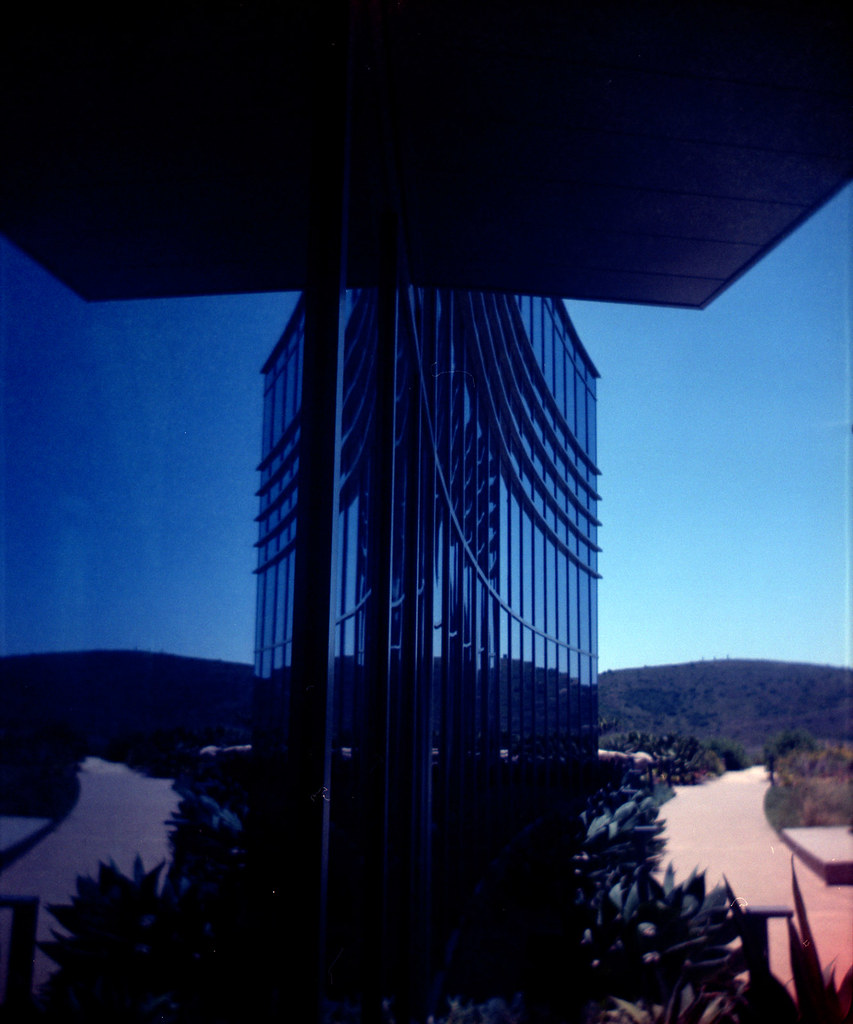
Reflected

The camera I used for the 35mm roll was a Kodak 35RF I got in a trade.
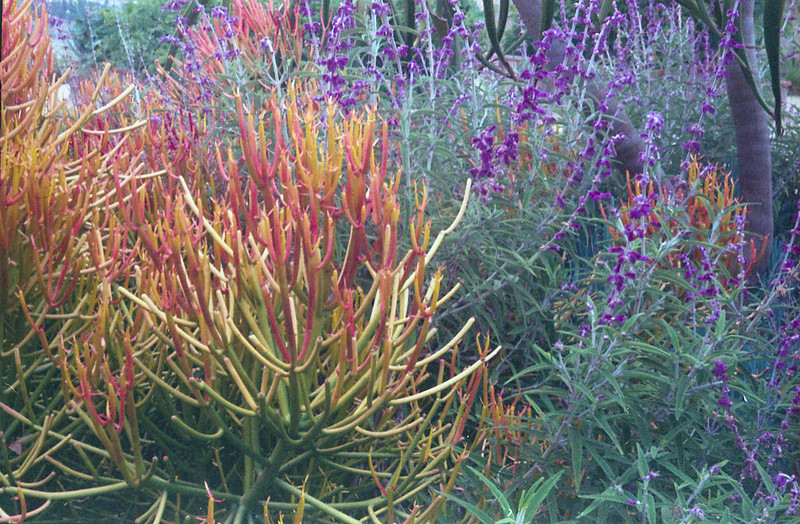
Pencils

Tuesday, December 24, 2013

2 Cameras, 2 Films, 1 Subject

I didn't really take these two photos with a blog post in mind, but I ended up scanning the films together and so the comparison was inevitable.

The first was taken with a c. 1939 Agfa PD16 Clipper. I wrote about this camera recently, so click the link to find out more about it. The film is expired (1981) Tri-X, so I expected some grain. I took the photo indoors near a bright-ish window, but still it was under-exposed for sure (probably f/5.6 at about 1/40th). The processing was done in Adonal diluted 1+100 with semi stand agitation (10 sec init and 10sec at 35min) for 70 minutes. That should have brought the grain under control a little, but I think the other factors were overpowering. The grain is "pronounced" to say the least. The contrast is low, the DOF is not bad, but I am a little too close to the subject, so it is soft. These work to emphasize the grain. So what I ended up with was a photo that looks very old indeed. I think the treatment actually works with this subject, so I am happy to share it.

The next one was taken with my trusty old (c. 1967) Nikkormat FTn with the awesome Nikkor 50mm f/1.4 lens. This lens has great clarity and contrast and takes pretty sharp photos if I do my part and hit the focus correctly. Development was identical to the image above, but the film was slower. Initially it was some generic "Professional Film" rated at asa (iso) 125. Being that it expired in 1981, I rated it at iso 50 and hoped for the best. I will definitely be posting some more photos from this film since I have 100 ft of it. It turned out quite nice, I think. Everything I would expect from this camera/lens and good film. There may be a bit more grain than it would have had 30 years ago, but it is nowhere near as pronounced as with the Tri-X above that expired in the same year.

I hope you have a wonderful Christmas. If you were nice, maybe Santa will put some expired film in your stocking!

Tuesday, December 17, 2013

Clipper

I had a few cameras given to me recently. One of them was a 1939 Agfa PD16 Clipper. This was made after Agfa (Germany) and Ansco (U.S.A.) merged and this was the first camera design produced by the new company Agfa - Ansco. You can find identical Clippers with both Agfa and Ansco badges on them. It has a simple Cooke Triplet lens, so the images are nice, but a bit soft. It is fixed focus from ~5 - 12ft. It has an aperture of around f/6.5 and a shutter speed of about 1/30th - 1/40th sec. So with modern films (especially b/w) with good exposure latitude, you can shoot anything from iso 50 in bright daylight to iso 400 (box speed) or greater indoors or in dim light. The camera has a little tab that pulls out to allow "bulb" exposures so that the shutter stays open as long as you hold down the shutter release button. There is no tripod socket, so it's probably best to find a sturdy surface on which to set the camera. The front 'standard' has a little foot to keep it level. This camera was designed for the 616 rollfilm format. This film was 70mm wide compared to 60mm of the 'modern' 120 format. So with a little fanangling, you can use 120 film. By 'fanangling' I mean 'get something to extend the 120 spools enough to fit the camera and turn with the film advance knob'. I have an associate with a 3-D printer, so he did me a favor and printed up a set of spool extenders that are designed for just this purpose. You will get images from edge to edge on the 120 film and the film may not be perfectly flat in the camera, so you might want to engineer a new 6x6 mask if these imperfections bug you. I'm fine with what I get, so no need for further 'improvements'. The images are about 5x6cm, which is a 'near square' format, but not as near as 6x7, so it makes it interesting.

Here is a poor photo of the spool extenders.

Clipper-Roll-Extenders

Here is an example of a photo I took with my Clipper. I used Kodak Tri-X expired in 1981 and stand developed in Caffenol-C-L.

At the Q-Bowl

I love using these old point & shoot cameras. It is super low-tech, so there's not a lot to think about aside from composition.