Showing posts with label red scale. Show all posts

Saturday, August 23, 2014

That's Just Crazy

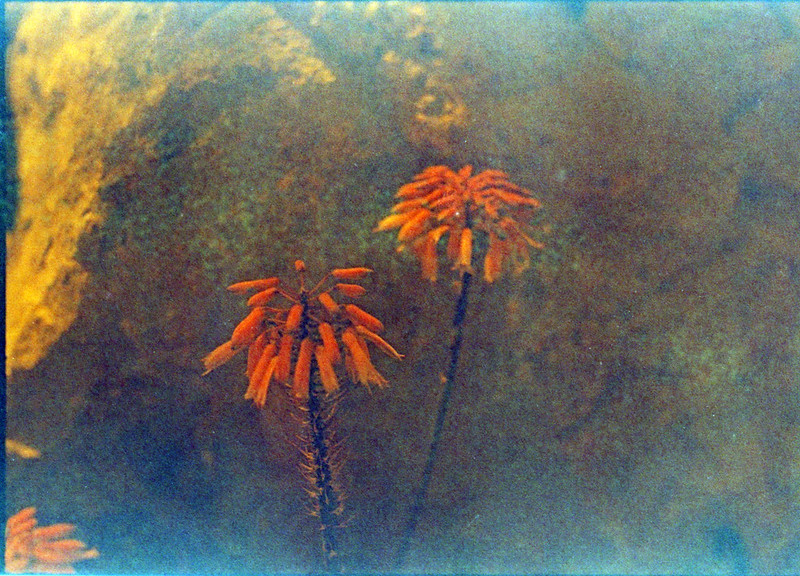
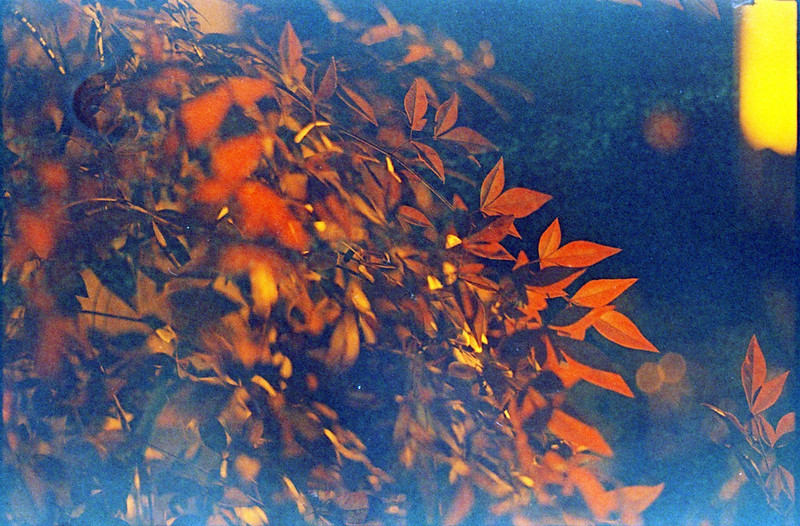
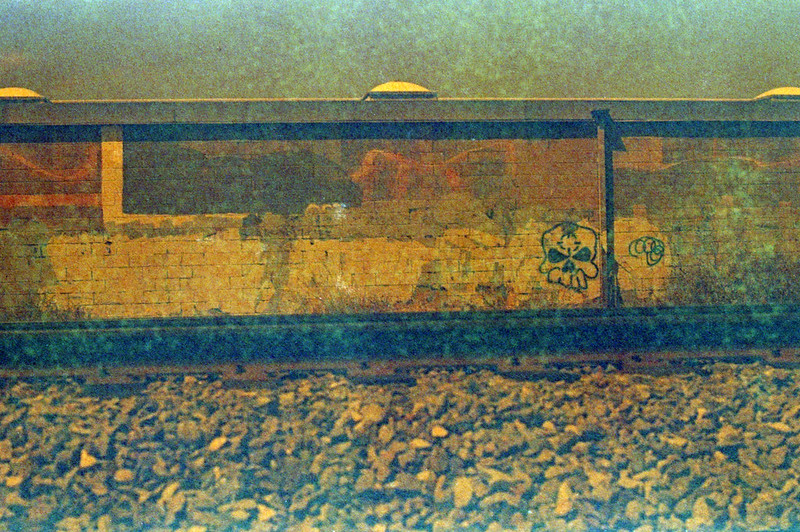
I traded some film with another Filmwaster. I sent him some expired FP4 and he sent me some expired Ektachrome 64 Daylight. He had exposed a roll and cross-processed it and didn't like the results, but I thought it was kind if cool. It had this blue/green color cast that was unique. I instantly thought that a little red would 'balance' things and add some contrast. Redscale would certainly do that. What's redscale? That's when the film is in the camera the 'wrong' way so that the emulsion side is facing the back and the light is passing through the base material first and the emulsion layers in the reverse of the intended order. It generally makes things look like you have shot them through a red filter, but with some color balancing magic, you can get some really cool effects. So I went into the darkened bathroom at my house and pulled the film out of its canister. I then clipped it off at the end, flipped it over and taped it back on the stub hanging out of the canister. Then I wound it back into the canister and trimmed the leader so that it would fit into the takeup spool of my '65 Nikkormat FTn. These shots were all taken with the Nikkor 50mm f/1.4 lens. The first part of the roll (about 20 exposures) I metered at iso 25. The next 8 shots were at iso 16 and the final 8 were at iso 8. I figured with that scheme, I would at least find out the best speed for this film when 'redscaled'. I developed in a Unicolor C-41 kit that is probably nearing the end of its life (but still good).

Here are a couple of shots from the roll. Head over to my Flicker album to see more.
redscale-029
redscale-016
redscale-013

Monday, June 10, 2013

"Exotic" films

Gasworks Forest

At first glance, you are thinking "James! Holy cow, take care of your freakin' white balance, will ya?" I thought that too, and I still do sometimes when I see a photo like this. But once you know what this is, you might gain an appreciation for it. This is "red scale" film and it is called that for obvious reasons. The colors are all 'shifted' toward the red end of the spectrum. So what is it and why use it?

Red scale film is simply regular color negative film that has been put on the spool with the emulsion side facing away from the lens. Ok, maybe I should back up a bit. Here is a diagram showing how modern color film is produced.
 Normally, layer 'a' would be facing the lens and light would pass through the layers in a-i order. The layers are made and balanced so that this produces an accurate rendition of the actual image in terms of human vision. However, if you put the film on the spool backward, the light passes through in i-a order. That means that it first passes through the antihalation layer, followed by the base, then the red layer. This completely turns the balance on end and strange things begin to happen. It isn't just taking a photo through a red filter. That would cause blues and greens to look very dark, but that isn't the look you get with red scale film. It is shifted in a strange sort of surreal way. It isn't just white balance either. Take a look at this image that was 'corrected' in PhotoShop for white balance.


Fixture

Now it is almost a sepia tone with the blue sky going grey and the whole thing giving a kind of monochrome (but not really) feel.

Next up is not really an exotic film as much as a misplaced one. What would happen if you took color transparency (slide) film and developed it in negative film chemistry? You would get what is called "cross-processed" images. The result depends on the film you start with and how you expose it, but in general, you are going to get increased contrast and potentially some color shifts. Some colors may saturate and others may wash out. You just have to experiment and see what happens.

Here is an image that I cross processed.

The bee and the coral tree

You can see that the sky has taken a very cyan color .The greens have saturated and the red of the coral tree flower has washed out to orange. To me it makes a kind of retro look as if the film or print has been left out in the sun. You can use regular Fuji Velvia (100 or 50) and either process it yourself or send it to a lab that offers cross processing (usually for a couple bucks more than regular E-6 slide processing). It is a lot of fun seeing what kind of results you get using unusual films or processes. Give it a try. Create something unique!!